
Why employer brand now has two questions, not one
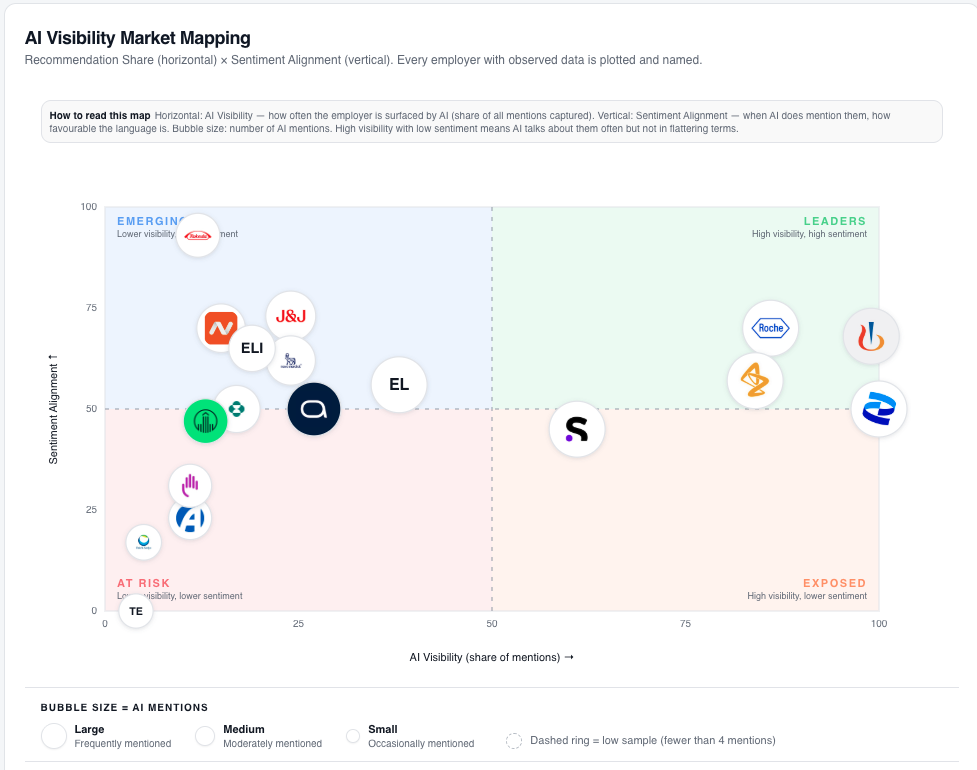
Visibility and sentiment have become separate measurements. The gap between them is usually where the real work sits.
01 · Market insight
For years, employer brand answered a single question: how are we perceived? Under AI-driven candidate research, that question has split in two, and the split changes what you measure.
The first question is whether you are named at all. When a candidate asks an AI engine which employers in a sector are worth applying to, you are either in the answer or you are not. This is visibility, and on its own it tells a candidate only that you exist.
02 · The two questions
The second question is how you are described once you are named. The same engine that decides to mention you also decides the language it frames you in, against the priorities candidates care about — pay, progression, flexibility, and the rest. This is sentiment, and it is what actually moves a candidate toward you or away.
Together, these two questions define the new employer brand problem. Visibility determines whether a candidate considers you. Sentiment determines whether they move closer or further away once they do. Neither can be inferred from the other, and neither is a substitute for the work of managing the other.
03 · Why they move independently
The reason these have to be measured separately is that they move independently. An employer can be the most frequently recommended name in its sector and still be framed in terms that steer strong candidates elsewhere, often inside the same response. Being recommended is not the same as being spoken well of, and a strategy that manages only the first leaves the second to chance.
This is the central shift. A high recommendation share does not automatically translate into a high positive sentiment. An employer that is visible but poorly described is still losing candidates at the point of decision, only more publicly than before. The more visible the employer becomes, the more the framing matters.
04 · Why the old playbook does not transfer cleanly
This is also why the old playbook does not transfer cleanly. When candidates researched through search results, visibility and perception blurred into one motion — you found the page and formed a view together. A generative engine pulls them apart. It decides whether to name you, then how to characterise you, and the candidate frequently sees only the synthesised answer, never the sources behind it.
The framing carries more weight than it ever has, because there is often nothing else for the candidate to read. The AI answer becomes the employer brand in that moment. A career site, EVP campaign, or Glassdoor rating may still exist, but the candidate may never reach them before the first impression has formed.
05 · The practical shift
So the practical shift is this. Stop asking only how your employer brand is perceived. Start asking two questions in parallel: are we surfacing, and when we surface, are we framed in a way that wins? The answers are often different, and the gap between them is usually where the real work sits.