The four positions on the employer brand map, and what each one should do next
Most employer brand advice ignores position. Under AI-driven candidate research, the right next move depends entirely on which quadrant you sit in.
01 · Why position decides the next move
Most employer brand advice treats every employer as if it has the same problem: be more visible, tell a better story, post more often. The trouble is that the right move depends entirely on where you already sit, and the most common mistakes come from employers doing the right thing for a position they are not actually in.
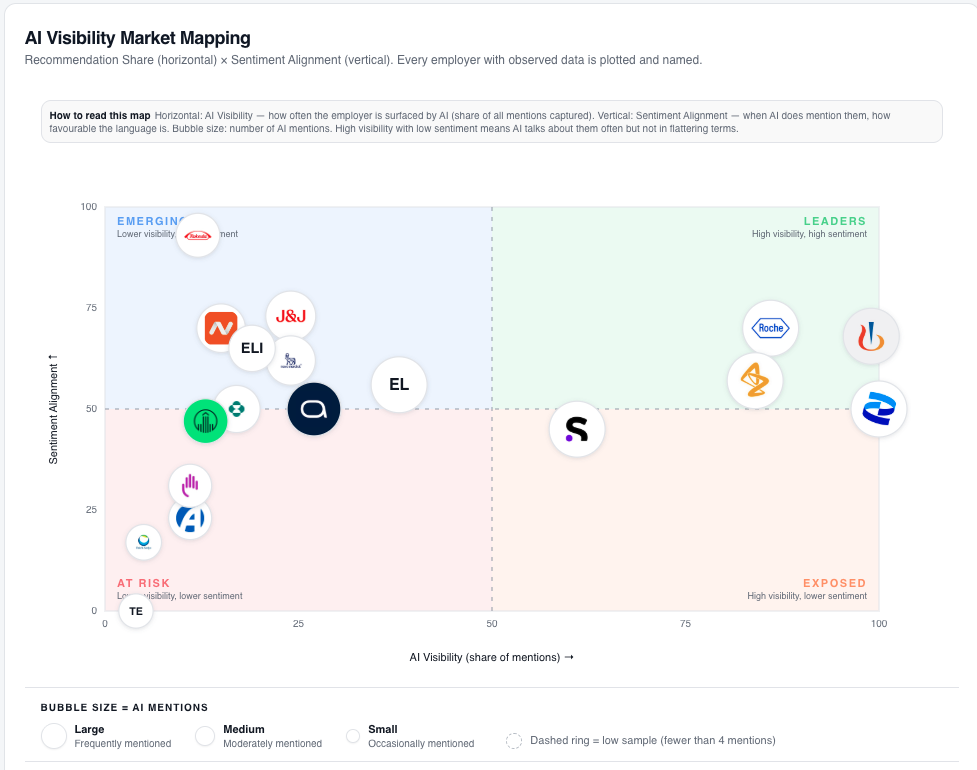
Under AI-driven candidate research, position can be read on two axes. The first is how often you are recommended — your visibility in the answers candidates get. The second is how positively you are framed when you do appear — your alignment with the priorities candidates weigh. Plot both and you get four positions, and each one calls for a different next move.
02 · Leaders — recommended often and framed well
Leaders hold high visibility and high sentiment. They are named frequently when candidates ask, and described in terms that work in their favour. This is the position every employer is aiming for, and the instinct, once there, is to relax.
That is the mistake. A leader's task is defence, not celebration. The language AI engines draw on shifts as new content, reviews, and coverage accumulate, so a strong position erodes quietly if it is not maintained. Leaders should be watching for the first signs of slippage on any single priority, because that is where a competitor will look to take ground. The work here is consistency — keep doing what built the position, and notice early when it stops working.
03 · Recommendation challengers — framed well but surfacing too little
Recommendation challengers are described positively, often more positively than the better-known names in their sector, but they do not surface as often. The substance is already there. The visibility is not carrying it.
For a challenger, reworking the message is wasted effort, because the message is already winning. The work is being named more often, through clearer, more specific, more attributable content that gives AI engines a reason to surface you. This is the one position where the honest answer really is more reach, and it is also the most frustrating to sit in, because you are losing to employers a candidate would prefer if they only knew you existed.
04 · Exposed — recommended often but framed poorly
Exposed employers hold high visibility and low sentiment. They are named frequently, then described in terms that steer strong candidates elsewhere. This is the riskiest position on the map, and the most counterintuitive, because everything that feels like success — the mentions, the reach, the recognition — is amplifying a story working against you.
The reflex for an exposed employer is to chase more visibility, which makes things worse. Every additional mention reinforces the characterisation. The work is the language, not the volume. You already have the attention; the task is changing what that attention says, priority by priority, until the framing catches up to the reach.
05 · At risk — low on both
At risk employers are largely absent from the conversation, and unconvincing on the occasions they appear. Low visibility, low sentiment. It is the weakest position, and also, in one sense, the cleanest, because there is no entrenched bad story to dismantle and no false comfort to give up.
The work here is foundational, and it has to happen in order. Substance first, because being more visible while poorly framed only moves you toward exposed, which is worse. Build a clear, specific, positive account of what you offer against the priorities that matter, then work on being surfaced. Sequence matters more for at risk employers than for any other position.
06 · Why naming your position changes the conversation
The value of the map is not the label, it is what the label rules out. A leader does not need a visibility campaign. A challenger does not need a messaging overhaul. An exposed employer should not be buying more reach. An at risk employer should not lead with visibility. Each of those is a real budget conversation, and getting the position wrong sends good money at the wrong problem.
It also changes the question you take to your team. Not the vague how is our brand doing, which invites everyone to have an opinion, but the specific which position are we in, and what does that position tell us to do first. That is a question with an answer, and the answer points directly at the work.
The hardest part is honesty about which quadrant you are actually in, because the comfortable assumption — that visibility equals strength — is exactly the one that leaves exposed employers spending on the thing that hurts them. Find your position first. The right next move follows from it, and it is frequently not the one that feels obvious.