The Evidence Hierarchy for AI Employer Recommendations
What AI trusts when recommending employers
01 · Market insight
Most employer branding content was built for humans. AI engines are forcing employers to think differently.
When ChatGPT, Claude, Gemini or Perplexity answer questions like "Which employers offer the best career growth?", "What is it like to work at Company X?" or "Which companies invest most in learning and development?", they are looking for evidence.
Not slogans. Not EVP statements. Not careers site marketing copy. Evidence.
The challenge for employers is that not all evidence carries the same weight. Some content simply describes what an employer wants to be known for. Other content provides measurable proof. The stronger the evidence, the easier it becomes for AI to confidently associate an employer with a particular attribute and surface them in candidate-facing answers.
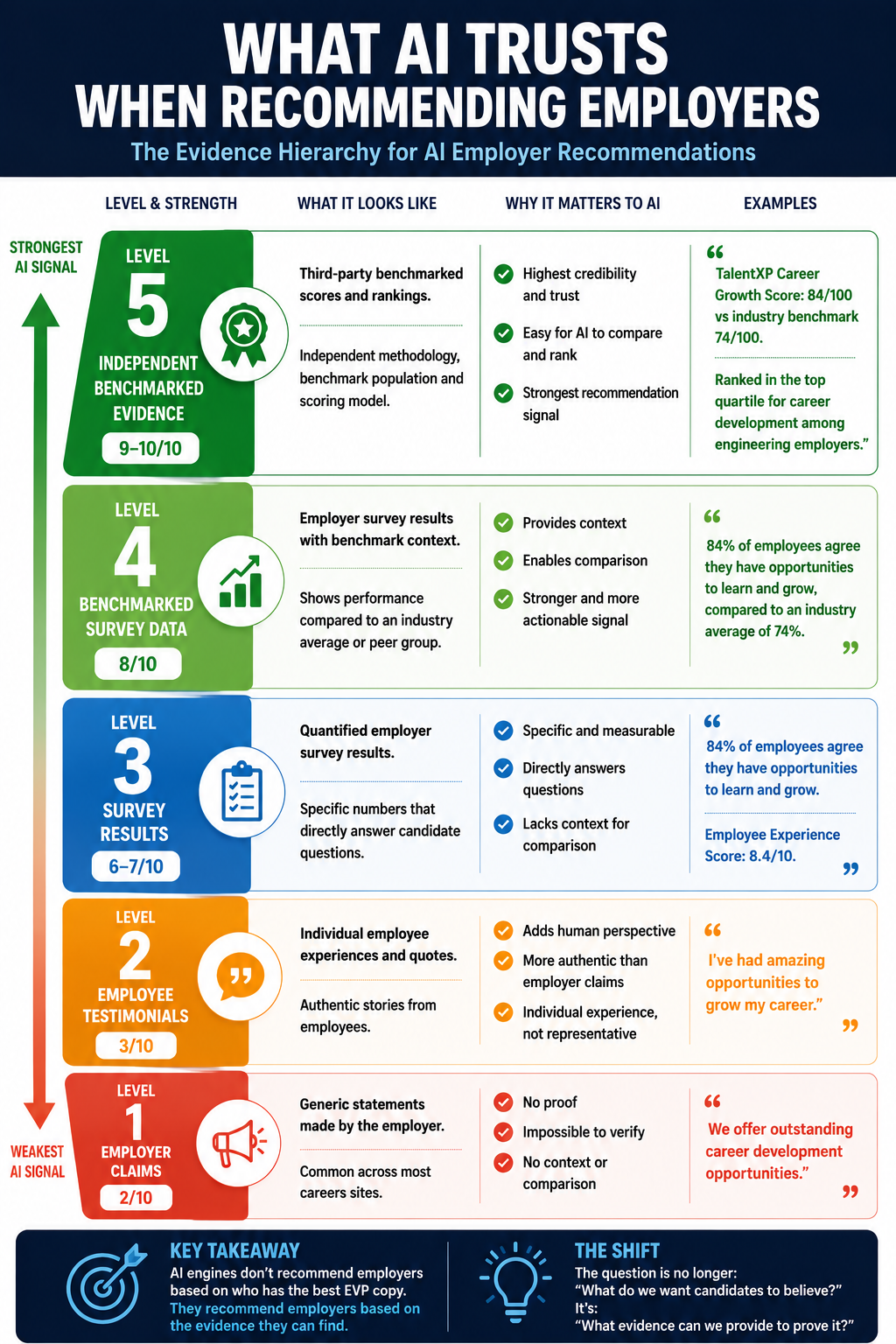
02 · Level 1: Employer claims (2/10)
Generic statements written by the employer themselves — common across almost every careers site.
Examples: "We offer outstanding career development opportunities." "We are committed to employee wellbeing." "We support flexible working."
These statements provide no proof and no measurable context. For AI engines, they are weak signals because they are difficult to verify and impossible to compare across employers.
03 · Level 2: Employee testimonials (3/10)
Individual employee experiences and quotes — "I've had amazing opportunities to grow my career." "The learning opportunities here have been fantastic."
Testimonials add human stories and authenticity. They are stronger than employer-written copy because they come from employees. The limitation is that they reflect individual experiences and aren't necessarily representative of the wider workforce.
04 · Level 3: Quantified employer data (6–7/10)
Specific numbers that directly answer candidate questions — "84% of employees agree they have opportunities to learn and grow." "Employee Experience Score: 8.4/10."
This is where things start to become much more useful for AI. Specific numbers provide measurable evidence and directly answer candidate questions. They are far stronger than generic claims.
The limitation is that AI has no context. Is 84% good? Average? Market leading? Without comparison, AI doesn't know.
05 · Level 4: Quantified data with benchmark context (8/10)
Examples: "84% of employees agree they have opportunities to learn and grow, compared to an industry average of 74%." "Employee Experience Score: 8.4/10 versus a benchmark of 7.2/10."
This is often where employers underestimate the value of their data. The benchmark provides context — suddenly AI can determine whether a result is above average, below average or market leading. The benchmark transforms data into a recommendation signal.
06 · Level 5: Independent benchmarked evidence (9–10/10)
Examples: "TalentXP Career Growth Score: 84/100. Industry Benchmark: 74/100. Ranked in the top quartile for career development among engineering employers."
This is where evidence becomes particularly powerful. The methodology, benchmark population and scoring framework are owned by a third party. The employer is not creating the score — they are publishing the result. This creates a level of credibility that AI systems can use with much greater confidence.
07 · Why reviews are not enough
Many employers assume employee reviews will provide all the evidence AI needs. The reality is more complicated. Many review sites restrict access to review content, and AI engines often cannot analyse thousands of reviews in real time.
Even when reviews are accessible, they tend to be unstructured. A single review might touch on career growth, leadership, flexibility, culture and compensation all at once. That makes it harder for AI to extract clear, measurable conclusions.
Structured data is much easier for AI to interpret. "TalentXP Career Growth Score: 84/100 versus benchmark 74/100" provides a far clearer signal than hundreds of individual reviews discussing career opportunities.
08 · Practical implications
Most employer branding content today still sits in Levels 1 and 2. The employers most likely to be surfaced by AI over the next few years will increasingly move towards Levels 4 and 5 by publishing:
- Employee experience scores
- Candidate experience scores
- Career development scores
- Onboarding scores
- Learning and development outcomes
- Benchmark comparisons
- Independent rankings
09 · The shift
The question is no longer: "What do we want candidates to believe?"
The question is: "What evidence can we provide to prove it?"
Because in the age of AI recommendations, evidence is becoming the new employer brand.