The No.1 employer brand channel that gives away millions of free advertising slots every day. And most employers are missing it.
AI answers have become a major employer brand channel. They put a small number of organisations in front of employees and candidates at the moment they are weighing a decision, and the placement cannot be bought.
01 · AI answers are a new employer brand channel
AI answers are the most innovative employer brand channel to emerge in a generation. More than 70% of candidates now use AI in their job search, and it costs nothing to appear.
Every day, millions of people ask AI about work. Which employers have the best culture? Where will I grow my career fastest? Who offers genuine flexibility? Who pays well? And increasingly: does my own employer measure up?
Each answer that names employers is, in effect, a free employer brand advertising slot. It puts a small number of organisations in front of someone at the moment they are weighing a decision. Unlike job ads or search campaigns, none of those slots can be bought.
That makes AI answers one of the largest free employer brand channels available, and one of the least actively managed.
02 · The scale of the channel
The volume of work-related questions is already significant. In the US alone, people send ChatGPT nearly 3 million messages a day about wages, compensation and earnings alone.
That is one topic, in one country, on one AI engine. Across all topics, ChatGPT handles more than 2.5 billion prompts a day.
For comparison, when Google for Jobs launched in 2018, around 150 million job-related searches were made on Google each month in the US. Employers learned to pay for visibility in those results. AI engines now receive questions about work at a similar scale, and visibility in their answers cannot be bought. It is free.
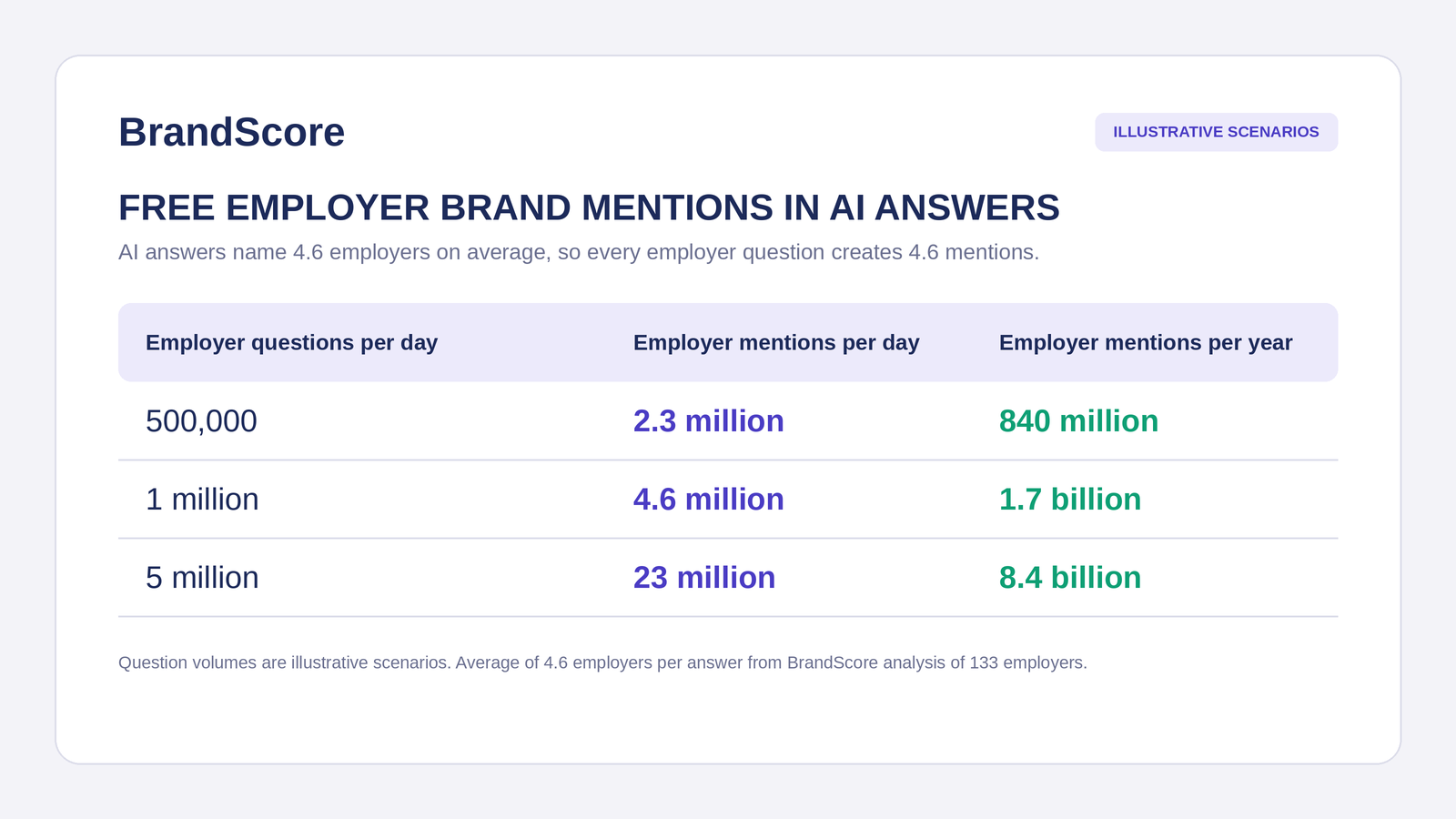
No published figure yet captures how many of those questions ask which employers to consider. But the arithmetic is simple. AI answers name 4.6 employers on average, so every question of that kind creates 4.6 employer mentions.
Even at the most conservative of these scenarios, AI answers deliver hundreds of millions of employer mentions a year. Each one is a free slot, and each one goes to a small group of employers.
03 · A missed opportunity when budgets are tight
The timing makes this more significant. With economic conditions tight, talent and employer brand budgets are under pressure, and every dollar spent on job ads, internal employer brand communications, search campaigns and agency fees is being scrutinised.
Yet the channel that delivers exposure at no cost is the one most organisations are not managing. While spend on paid channels is cut back, competitors that understand AI answer presence can build share in a channel that does not depend on budget at all.
For People leaders asked to do more with less, that is a rare combination: reach at scale, influence over employees and candidates, and no media cost. The investment required is not in placement, but in understanding where you stand versus your competitors.
04 · Not only candidates are asking. Your employees are too.
These slots matter for retention as much as attraction. Current employees have access to the same AI engines and can ask the same questions: how their employer compares on pay, culture and progression, and whether a competitor would be a better place to work.
As Will Innes put it in his recent article, this moves the issue beyond hiring into retention. It is a workforce, and therefore whole-of-business, risk.
The employers named in those answers shape how people see their current organisation, as well as the ones they might join. AI employer reputation is therefore a matter for People leaders, not only for recruitment.
05 · Free does not mean open
The slots are free, but they are not evenly shared. Each answer names 4.6 employers on average, from a market that may include dozens employing the same people.
Our analysis of 133 employers shows how concentrated that is. In 41.4% of AI answers that named employers, competitors appeared while the measured employer did not. For those organisations, the slots were being filled, just not by them.
The question for People leaders is therefore not whether the channel exists. It is how many of these free slots your organisation is winning, and how many are going to competitors.
06 · Your share of slots depends on your competitors
With so few places in each answer, position is relative. When a competitor strengthens its presence, it can move into the answer, and another employer drops out. An organisation can lose its share of slots or gain slots without changing anything itself.
The illustration shows how this plays out. Seventeen fictional employers compete for a place in a single AI answer. One employer moves into the answer, is pushed out while standing still as others move ahead, then returns as positions shift again.
Our monitoring shows the same pattern in real markets. Visibility moved by 7.6 percentage points on average within eight days. In September, one of the UK's largest banks disappeared entirely from AI responses on Purpose, Values & Culture, having featured the month before. And 68.7% of employers appeared through only one of the four AI engines we measure, so a strong position in one engine can mask absence in the others.
Every shift in a competitor's position changes the share of free slots available to everyone else.
07 · Why monitoring is the lever
In a paid channel, the lever is spend. Increase the budget and visibility follows. In AI answers there is no budget to adjust, so the lever is knowing where you stand and how that is changing.
A single check captures one day. Given how quickly competitors move, it can be out of date within a fortnight. It also cannot show whether a change in position came from your own activity or from a competitor's gains.
Regular measurement against a consistent set of talent competitors answers both questions. It shows how your share of slots is trending, which competitors are taking ground and where to respond.
08 · Implications for People leaders
Millions of free employer brand slots are filled every day. The organisations that know how many they are winning will be best placed to strengthen their presence over time.
- Recognise the channel. AI answers deliver employer brand exposure at a scale few paid channels can match, at no media cost, at a time when budgets are under pressure. Treat them with the same seriousness, covering retention as well as attraction.
- Measure your share, not just your presence. Track answer presence and favourability against the talent competitors contesting the same slots.
- Watch competitor movement. Their gains can reduce your share within a shortlist averaging 4.6 employers.
- Monitor continuously. In a channel you cannot buy, regular measurement is how you see movement in time to respond.