The First Zero-Sum Employer Brand: Why GEO Changes What Winning Actually Means
A strategic dynamic that didn't exist before
01 · Market insight
For most of the last twenty years, employer brand strategy has operated as a positive-sum game. Better careers content meant more candidate engagement. Stronger reviews meant more applicants. A sharper EVP strengthened the brand — and crucially, none of this came at the direct mathematical expense of any other employer. Two employers could improve their employer brands simultaneously, and both would benefit.
That assumption is quietly breaking. When candidates research employers through AI engines like ChatGPT, Gemini, Claude and Perplexity — and they increasingly are — the dynamics shift in a way that has no clean precedent. AI engines don't return long lists. They synthesise three to five named employers into their answers. Sometimes fewer. The answer is presented as authoritative rather than as a menu the candidate is invited to explore further.
Which means that, for the first time, employer brand work has become structurally zero-sum in a specific, measurable, and consequential way: when you win a slot in an AI recommendation, you are by mathematical necessity displacing another employer who would otherwise have been there — and the displaced employer doesn't appear anywhere else in the answer the candidate sees.
02 · What 'zero-sum' actually means, and what came before
It's worth being precise here, because there are versions of this argument that overstate the case and others that don't go far enough. Many parts of employer brand strategy have always involved competition. Job boards have sponsored placements that one employer wins and another doesn't. LinkedIn feeds have limited attention. Google search has a finite first page. Awards, conferences, and editorial coverage all involve competition for limited slots.
But across all of these, the system as a whole has been positive-sum in one critical way: the losing employer doesn't disappear. If you don't win the sponsored placement, your job listings are still on the board. If you don't rank on page one of Google, you appear on page two or three, visible to candidates willing to scroll. The long tail exists. Patient candidates and patient employers can still find each other.
AI recommendation breaks that pattern in a way nothing else has. When a candidate asks ChatGPT 'what are the best companies in Australia for career growth as a graduate?' the engine returns one answer — synthesised, named, finite. Five employers, presented with confidence, framed as the recommended set. There is no page two. There is no scroll. There is no long tail the motivated candidate can search through. The other fifteen, fifty, or five hundred employers who might genuinely have been relevant don't appear anywhere in the response.
That is genuinely new. Not 'more competitive than before.' Not 'smaller slot count.' But the disappearance of the long tail as a strategic surface at all. In every previous employer brand environment, losing meant being demoted. In AI recommendation, losing means being unmentioned — and unmentioned is functionally invisible to the candidate, who has no reason to suspect a long tail of employers exists beyond the answer they were given.
03 · Why this changes the strategic calculation
Three properties of AI recommendation make this dynamic structurally different from anything employer brand teams have worked with before.
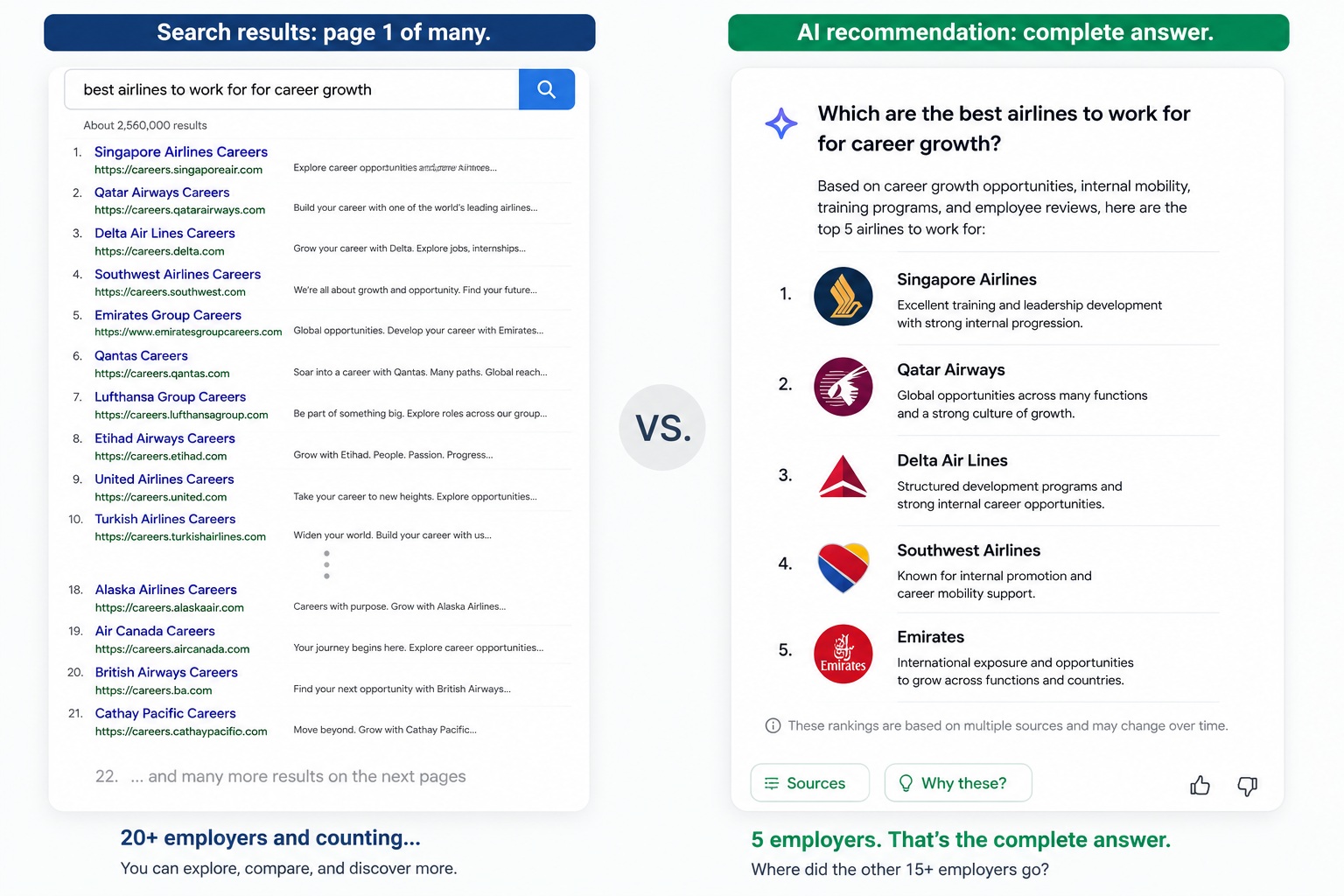
- The system is finite, not just compressed. Google's first page is finite, but it sits within a larger system the candidate can explore. AI recommendation contains only the synthesised answer. Finiteness without an underlying long tail is the defining structural property of this environment.
- The exclusion is invisible. When an employer doesn't appear on Google's first page, the absence is observable. When an employer is excluded from an AI synthesis, neither the employer nor the candidate knows it. The exclusion is silent — and silence is worse than visible loss because it can't be diagnosed or directly contested.
- The advantage compounds. Once an employer becomes a consistent presence in AI recommendations for a given theme, they become anchor evidence the engine cites in future answers. Displacement becomes progressively harder over time, not easier. Early movers compound; late entrants face a steeper climb.
04 · What this means for employer brand investment
If you accept that AI recommendation is structurally zero-sum in the way described above, several implications follow that would have been overstated in the previous era of employer brand strategy.
- Your investment is now relative, not absolute. Strategy without a clear view of who you're displacing — and who's displacing you — is strategy without coordinates.
- Sectoral concentration matters more than it used to. In high-concentration markets like Australian professional services, the slot competition is intense and well-defined. In less concentrated markets, slots are easier to win but less valuable.
- Defensive investment is now a meaningful category. For employers who currently occupy top slots, maintaining position is a strategic objective in its own right — one that didn't really exist before, because employer brand presence wasn't displaceable in the same way.
- Whitespace strategy becomes more important than rank strategy. The highest-leverage question is often not 'how do we get to top three for graduate career growth?' but 'which candidate priorities are currently undefended, and could we own them before someone else does?'
- The cost of waiting is now non-linear. Delayed investment costs you the time you weren't visible — and the position someone else built while you waited, plus the increased difficulty of displacing them later.
05 · A genuinely new strategic question
The deepest implication is one employer brand teams haven't really had to confront before, because the question didn't apply. In a positive-sum environment, the central employer brand question is 'how do we become better known and better regarded?' It's a question about yourself.
In a zero-sum environment, the central question shifts. It becomes: 'whose position are we trying to take, and what does that require?' It's a question about the competitive landscape. The answer requires modelling specific competitors, understanding why they currently occupy the slots, and working out whether displacement is possible, expensive, or unrealistic.
That's a different kind of strategic work. It's closer to category management in consumer goods or share-of-voice strategy in B2B marketing than to the relational employer brand work the discipline grew up doing. And it requires a different acknowledgement: that improving your AI-driven employer brand visibility is now, in a way it wasn't before, a competitive act. The slot you win is the slot someone else loses.
06 · Where this leaves Talent Acquisition and Employer Brand leaders
The implication isn't that employer brand work has become cynical or purely competitive. The vast majority of what TA and EB teams do — building real employee experience, telling honest stories, supporting candidate journeys — remains valuable on its own terms and benefits everyone in the long run.
But the layer of work specifically focused on AI recommendation visibility now operates by different rules than the rest of employer brand strategy. It's zero-sum where the rest is positive-sum. It compounds where the rest accumulates linearly. It rewards early movement where the rest tolerates patience. And it makes competitive position — whose slot are we taking? — a question worth asking explicitly.
The employers who recognise this dynamic early will treat AI recommendation visibility as a distinct strategic surface, with its own measurement, its own competitive analysis, and its own investment logic. The employers who don't will continue to apply positive-sum employer brand thinking to a zero-sum environment, and will quietly lose ground to competitors who saw the shift first.